Pont Adolphe

Pont Adolphe

Wednesday, 29 October 2014

* Do you speak Luxembourgish?

Did you know that Luxembourgish is one of the official languages of Luxembourg? In fact, it is one of three official languages alongside French and German. Despite fierce competition from such well established neighbours, Luxembourgish holds its own. I hear it many times a day in the supermarket, on the bus, and in Government. It was only officially declared a language in 1984 but has been rapidly increasing in popularity since then.

All three languages are taught at school and therefore most Luxembourgers are trilingual. Multilingualism is part of everyday life in Luxembourg and everyone slips happily from one language to another within the same conversation. This can be both a blessing and a curse for a Brit like me trying to improve her French and German. People love to practise their English and will often help you out while you struggle to find that word which has momentarily slipped from your mind.

As everyone can converse fluently in English, French, and German it seems surprising that Luxembourgish has not faded out of mind. Indeed, in 2013 Luxembourgish was declared ‘vulnerable’ by the   UNESCO Atlas of the World's Languages in Danger. UNESCO examines the domains in which a language is spoken in order to ascertain the threat to its existence. If a language is restricted to certain domains such as home or school then it is categorised as ‘vulnerable’. Approximately 390 000 people speak Luxembourgish but UNESCO estimate that only around 1/3 of children entering Kindergarten speak Luxembourgish as their mother tongue. However more and more people are learning Luxembourgish as a second or third language. In order to acquire Luxembourgish nationality, one is required to prove an adequate passive and active knowledge of Luxembourgish. This has resulted in increased numbers of people taking ‘language leave’, paid holiday to study Luxembourgish, or putting their children into local schools. Luxembourgish doesn’t look like it will be facing extinction any time soon.


Luxembourgish’s survival is even more remarkable because of its similarity to German. It is a Moselle Franconian dialect of West Central German. To a foreign ear they could easily be mistaken for the same language. Very similar Moselle Franconian dialects are spoken in many of the regions surrounding Luxembourg, including the German Eifel, Arelerland in Belgium, and in parts of Lorraine in France. The use of Luxembourgish and other similar dialects is not restricted by distinct geographical or linguistic boundaries; instead there is gradual change in the way people speak. Linguists call this a ‘dialect continuum’. Even within Luxembourg different dialects of Luxembourgish exist. Until the beginning of the 20th century, four dialects of Luxembourgish existed. However, due to the increasing usage of Luxembourgish in mass media and teaching in schools, a standardised version of Luxembourgish has emerged. 
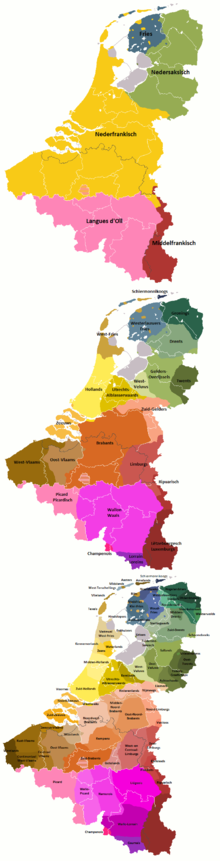


Dialect atlas showing different dialects in the Benelux region

Some linguists describe this process as ‘koinéization’: a process by which a standard language arises as a result of contact between two or more mutually intelligible dialects of the same language. ‘Dialect levelling’ is a more accurate description of the linguistic situation in Luxembourg. In this process, linguistic features in the central dialect of Luxembourgish found mainly in Luxembourg City are gradually replacing older dialect features of the regional varieties. Unlike ‘koinéization’ this does not result in simplification or reduction of the language structure but an increased level of phonological (the structure of sounds in a language) complexity. 

So why do the Luxembourgers feel so strongly about their national language? The history of Luxembourg can provide many answers to this question.  Between the fifteenth and nineteenth centuries Luxembourg was occupied by four different countries: Austria, Spain, France, and The Netherlands; each of which brought their own Germanic or Romance influences. Following the Treaty of London in 1839, Luxembourg’s current borders were defined and Luxembourgish became an important identity marker. Since the Second World War, Luxembourgish has become a symbol of national identity. Nowadays, as approximately 160 000 commuters a day cross the borders from France, Germany, and Belgium, and almost one half of the country’s population are foreign nationals, it is no surprise that Luxembourgish has high national-symbolic value.

I find Luxembourg’s linguistic patriotism refreshing. Luxembourg is a country that is both proud of its linguistic heritage and accepting of other tongues. Here in Luxembourg, people will communicate with you in which ever language you feel most comfortable with the goal of facilitating communication and establishing relationships.

References:
·         Wikipedia

·         Germanic Standardisations: Past to Present, Luxembourgish; Peter Gilles & Claudine Moulin

Wednesday, 1 October 2014

Pirates, puddings and public diplomacy


My first week as intern at the British Embassy to Luxembourg


From a room full of distinguished Naval officers and politicians discussing the threat of piracy on British trade to the arrival of thirty home-made cakes and accompanying Brownie Guides, my first week as an intern at the British Embassy to Luxembourg was varied and exciting.

      Piracy in Africa, British maritime policy, and a landlocked country seem like an unusual combination. But here in Luxembourg, at the heart of Europe, lies a complex network of European institutions, global businesses, and people of every nationality. This attracts interest from companies from all over the world who want to invest in Luxembourg’s wealth and trade opportunities. My week began with a lecture on dangers facing the maritime industry co-hosted by the Luxembourg Maritime Cluster and the British Embassy.  Despite Luxembourg’s land-locked position, it is an important base for shipping businesses and two speakers from the Foreign Office and the Royal Navy had come over to speak to the shipping community about the threat of Piracy and the affect on global trade. After being in Luxembourg just over 24 hours I was thrown into Embassy life and experienced firsthand the importance of the British Embassy in facilitating relations between British and Luxembourgish businesses.

The Ambassador welcoming guests 


   Less than a week later the same Residence was swarming with Brownie Guides and Rainbows who were anxiously awaiting the results of the Bake-Off competition. The Ambassador and Anne Faber, a Luxembourgish food journalist and celebrity cook, were presented with thirty cakes and marked them according to taste, texture, and appearance. Large amounts of sugar combined with the excitement of meeting the Ambassador in her very own house to create an air of excitement and conviviality. In fact, one Brownie Guide was compelled to ask the Ambassador, ‘Are you the Queen?’!


A selection of entries for the 'Great Guiding Bake-Off 2014'


      Public opinion can often be critical of government spending abroad and the expense of posting resident diplomats abroad. Telephones, emails, and video conferences all provide vital tools for doing business abroad without having to leave the office. Nevertheless, from what I have observed, the hospitality of the Ambassador and the genuine friendships that exist between the members of the Embassy team and the community of Luxembourg should not be undervalued. During my first week I have met a group of Luxembourgish Freshers bound for Cambridge, Supreme Judges at the European Court of Justice, Guide leaders, and senior business owners. These different groups have different motivations for maintaining a relationship with Britain. Some are motivated by money and investment opportunities and others are drawn to the educational benefits or the appeal of British baking! In each case, the friendship and hospitality of the Ambassador and her team goes a long way in promoting business and relations between the UK and Luxembourg.


Friday, 4 April 2014

Short but Sweet: A Week in Luxembourg

Having spent a substantial amount of time at university studying the ‘isms’ of International Relations theory – realism, liberalism, constructivism, and so on – my brief stint in Luxembourg has allowed me a glimpse into how international relations work in the ‘real world’. I now realise just how varied the role of the embassy is; from lobbying Luxembourgish ministers to hosting drinks receptions to conducting research, diplomats engage in a wide range of activities to promote Britain abroad.


Image credit: ironlineamerican.edu


Accompanying HM Ambassador to an exhibition of Dutch paintings alerted me to the importance of networking. While we spent a decent portion of time viewing the various pieces on display, I was also interested to see how many interesting people I had the opportunity to chat with. I had not previously considered this aspect of diplomacy but it is in fact an important part of the job. After all, informal face to face encounters are an effective means by which to keep up to date on current developments.


Enjoying the art. Image credit: www.clearharmony.net


An afternoon spent with a representative of UK Trade and Investment shed light on why foreign direct investment and exports are so beneficial to the UK and how UKTI works to increase these.


FDI and exports: key to economic health


Finally, attending a reception held at HM Ambassador’s residence for a local ladies cricket club highlighted the role the embassy plays in supporting local Britons and promoting British culture.


Maidens cricket club reception. Image credit: Romain Schanck, wort.lu


All in all, my visit, though fleeting, has proved thoroughly worthwhile. I have improved my knowledge of diplomacy while also having time to experience the small but charming and elegant City of Luxembourg.

Friday, 28 March 2014

Luxemburg, Äddi!

Three months ago, I arrived in Luxembourg. In spite of the dark and cold, January was actually a great time to set up camp. What better way to start the New Year than in a new place, doing new work, meeting new people, gaining new experiences, and all in a country that had a new Prime Minister for the first time in 19 years.
 
Luxembourg's colours and beloved Red Lion
Since day one, work has been a healthy combination of challenging and interesting. With the Embassy being quite small, I have been able to gain an insight into what each member of the team does, and to help out with a large variety of tasks and projects. The working day has thus been wonderfully varied, which is always a bonus. Furthermore, I’ve been able to learn more about the UK’s engagement in foreign and EU affairs, and I feel better acquainted with how the FCO and its many missions operate. Until seeing it in action, such a complex machine is quite hard to visualise, but my understanding of it has certainly begun to solidify. It has also been fascinating to see how the small country of Luxembourg has been coping with the changes to its administration, and how it has been responding to regional problems, national developments, and international crises. You could perhaps say that the Embassy has been the lens of a microscope that is trained on a selection of slides exhibiting some Foreign Service cells, EU molecules, and Luxembourgish DNA.

Luxembourg doesn't quite have a green glow yet, but maybe when summer comes...
 Developing a deeper understanding of Luxembourg’s administrative skeleton has been great; discovering its flesh – that is to say the populace – has been equally charming. Luxembourg is a great place to go, regardless of how many people you expect to know there: there is little anonymity and people are extraordinarily welcoming. Someone I met here said that everybody is nice to everybody else because they never know when they are going to meet again! Ostensibly cynical though this may be, there is some truth in it. In a place like London, all odds would be against a second meeting, but here in Luxembourg it’s a veritable likelihood. Furthermore, the variety of people I have met is astounding. There are people from all over the world and all walks of life, and it has been wonderful to see how they all come together in this brimming melting pot. 
If this pot is Luxembourg, what's inside is the most varied meal anyone's ever had
A recent addition to the Luxembourg creuset was Father Michael Lapsley, a South African priest, in town to launch the German-language version of his autobiography. During his book launch, he spoke of his experiences campaigning against the apartheid regime, before and after receiving in 1990 a letter bomb that blew off his hands and caused him to lose one eye. His story was compelling, to say the least. He addressed issues such as disability, trauma, and healing, and said he was grateful that the letter bomb had taken only his hands, leaving his greatest weapon, his tongue, perfectly intact. He propounded the need for individual independence, but also for individuals to be interdependent, and explained his understanding of forgiveness and justice, and how the two can be reconciled, in his view. It was an exceedingly thought-provoking event.

Fr Michael's autobiography, in German:  Mit den Narben der Apartheid: Vom Kampf für die Freiheit zum Heilen traumatischer Erinnerungen

And that same sentence could be re-applied to so many of the experiences I’ve had here; my mind has been kept happily scurrying. Just this week, I had the pleasure of meeting and attending a talk given by British rower, Steve Williams, OBE, two-time Olympic Gold medallist, and four-time world champion in the men’s coxless four. He was not there to promote his sport (the many descriptions of excruciating and constant pain could entice no-one but an extreme masochist); his focus lay elsewhere. Lots of what he said was about self-motivation, but he spoke equally about how to be a good team player, and a significant proportion of his talk was centred on being a good leader. Really, it spoke to everyone in some way; even if it did nothing to convince anyone that it would be fun to get up at 6am for an icy row, this indomitable athlete used his personal sporting anecdotes well in order to transmit some universally applicable mantras.
Steve Williams and his two Olympic Gold medals
Now, three months on from all the newness, it’s time for me to leave. The time I’ve spent here in Luxembourg is one I won’t be forgetting. Firstly, because I feel the skills I’ve learnt will stick with me for a long time, and secondly, because it has been such an enjoyable experience. Not just because of events like those elaborated upon above, but because of the work itself, its varied nature and fascinating substance, and because of the environment in which that work has taken place. The Embassy staff have been as welcoming as the Luxembourgers themselves, and working with them has been a treat. I’m really very grateful to have had the opportunity to intern here.

Friday, 14 March 2014

United in Diversity

March has not only seen a rise in temperatures, but also the dawn of Luxembourg’s presidency of the UN Security Council, and what a month to start. Luxembourg’s first action was to hold an emergency meeting on Ukraine during their very first day in office, and it has been all systems go ever since, what with the Benelux Foreign Ministers' visit to Kiev, and a heavy existing Security Council agenda. As a result, there has been much interaction with the Foreign Ministry, which has provided me with a remarkable insight into diplomacy. The best way I can describe this is that it reminds me of a wicker basket being woven, but where each individual twig is being woven by a different country: all weavers have the same goal (to create a basket), but each has a slightly different idea about the pattern. It’s all about the weaving process: how they work off each other, communicate, cooperate, compromise, and deal with clashes. At any rate, even if that made no sense, take my word for it that it’s fascinating.
Diplomacy in its figurative form. Image credit: prestigewicker.co.uk.
As well as this more politico-centric activity, the Embassy has been kept busy with its first Consular Outreach Reception, which took place on the second Tuesday of the month. It was a great event: firstly, it gave me the chance to understand the role of our consular services in far greater detail, and secondly, the Embassy was able to celebrate some extraordinary people, such as volunteers at homeless shelters and leaders of groups for women in distress. Not only did it allow our consular team to establish contact with local support groups, schools, hospitals, police forces, and charities, amongst others, but it gave all these the perfect opportunity to meet each other as well!

Networking. Image credit: ekaterinawalter.com
To further consolidate the Embassy’s relationship with local organisations, the Ambassador has also been to visit two of the local schools, and I accompanied her: one was an international school, where the Ambassador gave a careers talk to some keen sixth-formers, and the other a Luxembourgish school, where pupils in their first year of learning English wanted to learn more about the Ambassador’s role and be inspired to work hard at their English. They were using vocabulary and grammatical structures that were astonishingly advanced for the short length of time they had been learning; the teacher informed me that their grammar had been grounded the previous year by a course in Latin, and I suppose their exposure to an abundance of English media and American television must aid their language retention. Still, it was impressive. And it underlined another positive facet I’ve noticed of Luxembourg: that it seems to be a great place to bring up children; certainly, the advantages they’ll gain from such a fabulous education in languages are innumerable.

Image credit: worldnomads.com
These bonds with Luxembourgish professionals, which the Embassy staff work so hard to establish and nurture, have even proven themselves useful for one of my assignments. Part of my remit over the past few months has been to plan a commemorative exhibition about the bilateral relations between Luxembourg and the UK during the First World War, and recently the planning process reached the stage where we were ready to go to external organisations and enquire about potential artefacts we might be able to borrow. Amongst those organisations contacted were the national archives, the city archives, the photo archives and the Military History Museum in Diekirch, a town north of Luxembourg City. The particularly great thing about this stage of the process was that I got to visit all these places and rifle through their fascinating material myself. My now extremely high expectations of Luxembourgers’ charm were not disappointed; everyone I met at each of these institutions was intrigued by our narrative and eager to help. It will be exciting to get the chosen material together in one room later this year.
  
National Military History Museum in Diekirch.
 On the subject of historical war, I should mention that Luxembourg has been playing host to a home-grown cinema hit. The film, Heemwéi – Eng Odyssee (translation: Homesickness – an Odyssey), is the result of a seven-year independent project that cost just €25,000. It was realised by a team of volunteers, amateurs and local professionals in Luxembourg. Having wanted to watch it since its release in January, I finally did, and was duly impressed. The film revisits Luxembourg’s ambiguous WWII history, where the line between friend and foe was exceptionally vague. There is nothing sensational or condemning about the story; the depiction is realistic and gritty, and this translates into a thought-provoking production. I found it an interesting window into Luxembourg’s relationship with its past.


For, although Luxembourg is an extremely modern place, full of innovation and enterprising, it does still retain a link with its history. This I was fortunate enough to experience last weekend (the second weekend in March), when each commune held a traditional – in fact pagan – ceremony to cast off the throes of winter and welcome in the spring. This ‘Buergbrennen’ took the form of a gigantic cross-shaped bonfire, accompanied by much food, drink, and merriment. The one I attended was lit by a troop of intrepid children and run by the scouts, and it burned rather spectacularly. Bonfires in other communes were even supplemented by fireworks and music. Essentially, it was nice to see that, in spite of the patchwork nature of Luxembourg’s population, a healthy native community spirit has remained intact.

Buergbrennen in Beggen.
Since being here, I’ve been struck by Luxembourg’s diversity; in more recent weeks, the interwovenness of this diversity has really made itself apparent. It is not a school canteen, where the groups and cliques are distinct. Here, old sits with new, locals sit with expats, people of various professions happily share a table. Luxembourg thus seems to have successfully implemented the ostensibly paradoxical motto of the European Union: ‘United in Diversity.’

Wednesday, 5 March 2014

February: The Month of Flying Time.

At the Embassy, life is perhaps best analogised by the Luxembourgish weather. One minute, there is rain, the next snow, then glorious sunshine, followed by some fog, and rounded off with a bout of gusty gales. The temperature is as changeable, too. But whereas this might be a bad thing for holiday-making hikers trying to travel light, it’s great for an intern drinking in new experiences. It isn’t just the workplace that’s varied, though; it’s the ‘extra-curricular’ stuff, too…

This bright sunshine followed a solid two-day stint of downpours.
A couple of weeks ago, there was a great event put on by Delano, an English-language magazine, in celebration of its third birthday. The event was named ‘Spice It Up’; everything was Indian-themed, including the canapés, and all guests were invited to have a bindi drawn onto their foreheads. The venue was one that I would perhaps cringeworthily describe as ‘cool’, and it was a terrific place to meet new people and fill more gaps in my overall understanding of how Luxembourg works. As I moved through the crowd, evidence of the smallness of the world came in the form of my meeting two people with connections to my home-city of Manchester, which was unexpected, but welcome! A friend then introduced me to another guest, telling me that ‘he’s a magician!’ I, having been so used to people telling me they worked for a bank, insurance company or law firm, didn’t really take this assertion seriously, and made the poor man perform a trick to prove himself. He obliged, and produced a coin out of thin air. Bravo. It was only afterwards that I found out he was the internationally renowned magician, David Goldrake, who goes on world tours and is essentially the Luxembourg equivalent of Derren Brown. Oops.


The following week was the week of Valentine’s Day, and the English-speaking Actors Repertory Theatre Luxembourg put on, appropriately enough, Love Letters, a play by A. R. Gurney. We were invited. The play was a finalist for the Pulitzer Prize in Drama back in 1990, but in spite of its credentials, I must admit that I was not sure I was going to like it. Fifty years’ worth of love letters between two people, and only these two characters on stage at all times? It sounded so mushy. Fortunately, it was anything but! It was funny, moving, and engaging, and the production was simple but effective; the acting was understated, but sincere and convincing. In all, a play deserving of its renown.


Flyer for the Actors Rep production.
On Valentine's Day itself, there was an event held in the centre of town, which some Embassy staff, including myself, attended. It was called '1 Billion Rising for Justice', and was staged almost simultaneously in hundreds of cities across the globe. Organised by the American Women's Club of Luxembourg, it was done in conjunction with the global campaign, One Billion Rising. The campaign’s name comes from the appalling fact that one third of all women on our planet will be raped or beaten in her lifetime. That’s one billion women. These V-Day events, which take place on a yearly basis, give people the opportunity to raise awareness of this deplorable statistic, and to fight to end such widespread violence against women. Unfortunately, the weather on the day prevented a fantastic turn-out, but there was still a substantial number of attendees gathered in Luxembourg City centre. There were signs, music, photographs, and even some Zumba to rally the troops! The aerobic dancing was definitely welcome on such a cold afternoon. And it was good to see so much support for such an important issue.


A t-shirt on display on the day. Many were wearing them as well!
Last week saw my greatest challenge since starting at the Embassy. I agreed to give a quasi-motivational talk about London to a cohort of insurance salespeople; the company was planning a staff trip to London in celebration of hard work. My speech was meant to provoke excitement and give them a flavour of what they might expect from the UK’s capital. There was one complication, which only came to light once I had agreed to do this for them: the speech had to be in French. I speak French, but conversing and giving a speech are quite different things, and I had no previous experience of the latter. Fortunately, though, it turned out to be a worthwhile endeavour and an excellent experience: not only were my hosts delightfully encouraging despite my evident nerves, but I did not spontaneously combust mid-sentence, which I figured was the worst that could happen. Afterwards, conversation was facilitated by Guinness, which was served to further excite the employees to want to go to the UK and sample more British Ale [sic: I felt it was polite to refrain from mentioning that, actually, Guinness comes from a little place slightly west of Britain…]. What’s more, I then received a beautiful vase of flowers in the post after the event, which was a lovely surprise, and also served as yet further confirmation that Luxembourgers are an absolutely charming bunch of people.

Luckily, London is fab, so the content of the speech was easy.
And now it’s March! I can barely believe it; into the home stretch now. The speed at which these past two months have evaporated before my eyes certainly supports the old assertion that ‘time flies when you’re having fun.’

Friday, 7 February 2014

The English Pronunciation of 'Ukulele' is Illogical.

Last week, I was delighted to attend a talk given by Sir Nigel Sheinwald. The former UK Ambassador to the USA (and former UK Permanent Representative to the EU) was in Luxembourg to give a talk for the Oxford University Society of Luxembourg, on the topic of ‘Britain, Europe and the World: present dilemmas and future decisions.’ It was very interesting to hear his perspective on such matters, especially given his professional proximity to the people, organisations and countries involved in many of the issues of which he spoke.

University of Oxford

In the discussion that followed, British people’s perception of the EU was discussed. As this group of predominantly older Britons and Luxembourger Oxford graduates discussed why there were so many eurosceptics in the UK, and to what sort of information young Brits were being exposed, I felt like I ought to raise my hand and say ‘hello, young Brit, here…’, but they actually nailed the issue on the head without my help: the usefulness of the EU is barely publicised in the UK, whereas its few disadvantages are preyed upon and strung up as a grim – and slightly misleading – warning to us all. It seems to be a matter of awareness, and it’s a shame that such discussions aren’t had on a broader scale in the UK itself.

File:Flag of Europe.svg
The European Union flag
After this talk, the British Ambassador hosted an informal dinner at the Residence in honour of Sir Nigel, which gave those present the opportunity to discuss in further detail the ideas brought forth in the talk (amongst other things, of course). There were fourteen people present, and every single one of them had an entirely unique perspective on every topic of conversation, having come from all sorts of different backgrounds and had a variety of completely different experiences. That is one of the things I have found about Luxembourg: there is a wealth of diversity here, and it is great.

***

This diversity is visible in every single vein of Luxembourg life: I went into a shoe shop the other day, and after confessing to the sales assistants that I spoke no Luxembourgish, was promptly re-greeted in English, and good English at that! Not only that, but most films at the cinema are shown in their original language, with a relevant combination of English, French, German and/or Luxembourgish subtitles (which is a great excuse to go often, because it’s therefore technically educational…). There are ways of settling into this place no matter where you come from or what language you speak (well, ok, there are some limits to how multilingual everyone is).

EU flags flying before the European Parliament

This is great for places like the theatre, as I experienced in my first week at West Side Story, but also for the Luxembourg Philharmonie, which is able to welcome a vast array of English-speaking talent without worrying about a drop in ticket sales. This was evidenced by their hosting of the Ukulele Orchestra of Great Britain, who only went and, you know, sold out.

Luxembourg Philharmonie

I was very excited to go along to this, because some friends of mine are Ukulele players, and I had therefore heard good things about the troop. Good things which turned out to be true, I might add. The colourful range of songs on their set list and their witty choreography were only outshone by two further aspects of their performance: firstly, the complexity of the layered arrangements, at which one could only marvel (think Pitch Perfect, but with EIGHT SONGS ON THE GO SIMULTANEOUSLY); and secondly, crucially, their bewilderingly enduring manual stamina! The non-stop speed at which they twanged away together was unbelievable, and that is without so much as mentioning the rapidity of the solos and the fact that each member had to sing as well. They deserve serious kudos. However, it was not just awe at their skill that made the evening enjoyable. Despite having been playing together for nearly thirty years, their material was fresh and buoyant. There were songs by Adele and Daft Punk, featured amongst hits by David Bowie, Lou Reed, and even Frank Sinatra. There was even a whistling interlude. Possibly my favourite rendition of the night, though, was an acapella ‘folkalisation’ (yes, that is a made-up word, but how else will language evolve?) of The Who’s ‘Pinball Wizard’. You’d have thought the song had originated in medieval Scotland, or had been written for the soundtrack of Braveheart. ‘Twas bonnie.


The Ukulele Orchestra of Great Britain

The second two weeks in Luxembourg have proven themselves well up to the task of following the first; I’m discovering ever more about this small country, and, so far, I like it.


Note with reference to the title: we Brits pronounce each of the four vowels differently: 'you-kuh-lay-lee'. German is far more logical: it goes 'oo-koo-lay-lay'. Something I realised when talking to a German friend who was baffled by our linguistic silliness.