
March has not only seen a rise in temperatures, but also
the dawn of Luxembourg’s presidency of the UN Security Council, and what a
month to start. Luxembourg’s first action was to hold an emergency meeting on
Ukraine during their very first day in office, and it has been all systems
go ever since, what with the Benelux Foreign Ministers' visit to Kiev, and a heavy existing Security Council agenda. As a result, there has been much interaction with the
Foreign Ministry, which has provided me with a remarkable insight into
diplomacy. The best way I can describe this is that it reminds me of a wicker
basket being woven, but where each individual twig is being woven by a
different country: all weavers have the same goal (to create a basket), but
each has a slightly different idea about the pattern. It’s all about the
weaving process: how they work off each other, communicate, cooperate,
compromise, and deal with clashes. At any rate, even if that made no sense,
take my word for it that it’s fascinating.
 |
| Diplomacy in its figurative form. Image credit: prestigewicker.co.uk. |
As well as this more politico-centric activity, the Embassy
has been kept busy with its first Consular Outreach Reception, which took place
on the second Tuesday of the month. It was a great event: firstly, it gave me
the chance to understand the role of our consular services in far greater
detail, and secondly, the Embassy was able to celebrate some extraordinary people,
such as volunteers at homeless shelters and leaders of groups for women in
distress. Not only did it allow our consular team to establish contact with
local support groups, schools, hospitals, police forces, and charities, amongst
others, but it gave all these the perfect opportunity to meet each other as
well!
 |
| Networking. Image credit: ekaterinawalter.com |
To further consolidate the Embassy’s relationship with
local organisations, the Ambassador has also been to visit two of the local
schools, and I accompanied her: one was an international school, where the
Ambassador gave a careers talk to some keen sixth-formers, and the other a
Luxembourgish school, where pupils in their first year of learning English
wanted to learn more about the Ambassador’s role and be inspired to work hard
at their English. They were using vocabulary and grammatical structures that
were astonishingly advanced for the short length of time they had been learning;
the teacher informed me that their grammar had been grounded the previous year
by a course in Latin, and I suppose their exposure to an abundance of English
media and American television must aid their language retention. Still, it was
impressive. And it underlined another positive facet I’ve noticed of
Luxembourg: that it seems to be a great place to bring up children; certainly, the
advantages they’ll gain from such a fabulous education in languages are
innumerable.
 |
| Image credit: worldnomads.com |
These bonds with Luxembourgish professionals, which the
Embassy staff work so hard to establish and nurture, have even proven
themselves useful for one of my assignments. Part of my remit over the past few
months has been to plan a commemorative exhibition about the bilateral
relations between Luxembourg and the UK during the First World War, and recently
the planning process reached the stage where we were ready to go to external
organisations and enquire about potential artefacts we might be able to borrow.
Amongst those organisations contacted were the national archives, the city
archives, the photo archives and the Military History Museum in Diekirch, a
town north of Luxembourg City. The particularly great thing about this stage of
the process was that I got to visit all these places and rifle through their
fascinating material myself. My now extremely high expectations of
Luxembourgers’ charm were not disappointed; everyone I met at each of these
institutions was intrigued by our narrative and eager to help. It will be
exciting to get the chosen material together in one room later this year.
 |
| National Military History Museum in Diekirch. |
On the subject of historical war, I should mention that Luxembourg
has been playing host to a home-grown cinema hit. The film, Heemwéi – Eng Odyssee (translation: Homesickness – an Odyssey), is
the result of a seven-year independent project that cost just €25,000. It was
realised by a team of volunteers, amateurs and local professionals in
Luxembourg. Having wanted to watch it since its release in January, I finally
did, and was duly impressed. The film revisits Luxembourg’s ambiguous WWII
history, where the line between friend and foe was exceptionally vague. There
is nothing sensational or condemning about the story; the depiction is realistic
and gritty, and this translates into a thought-provoking production. I found it
an interesting window into Luxembourg’s relationship with its past.
For, although Luxembourg is an extremely modern place,
full of innovation and enterprising, it does still retain a link with its
history. This I was fortunate enough to experience last weekend (the second
weekend in March), when each commune held a traditional – in fact pagan –
ceremony to cast off the throes of winter and welcome in the spring. This ‘Buergbrennen’
took the form of a gigantic cross-shaped bonfire, accompanied by much food,
drink, and merriment. The one I attended was lit by a troop of intrepid
children and run by the scouts, and it burned rather spectacularly. Bonfires in
other communes were even supplemented by fireworks and music. Essentially, it
was nice to see that, in spite of the patchwork nature of Luxembourg’s
population, a healthy native community spirit has remained intact.
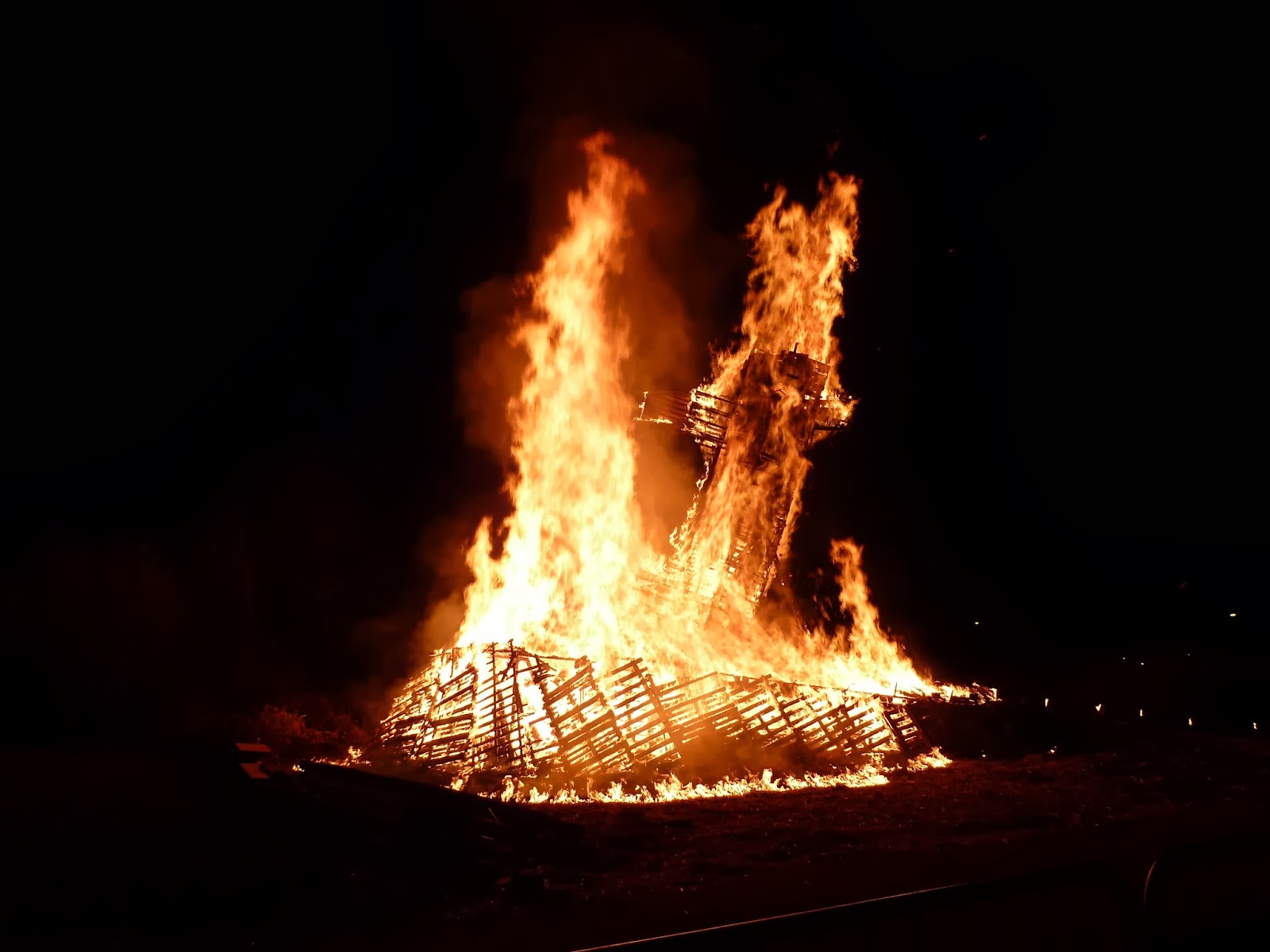 |
| Buergbrennen in Beggen. |
Since being here, I’ve been struck by Luxembourg’s diversity;
in more recent weeks, the interwovenness of this diversity has really made
itself apparent. It is not a school canteen, where the groups and cliques are
distinct. Here, old sits with new, locals sit with expats, people of various professions
happily share a table. Luxembourg thus seems to have successfully implemented
the ostensibly paradoxical motto of the European Union: ‘United in Diversity.’


